Apr 2, 2026

Umstead 2026: 50 in 14:21:51


I want to start with Blake Norwood. Blake Norwood founded Umstead. He built something so good, so well-designed, so beloved by the ultrarunning community that it has outlasted him and will outlast all of us. He died in 2014 and people who never met him cry a little when his name comes up at the pre-race briefing. He also coined the motto that is printed on things, stitched into the culture, and stated clearly to every runner before every race:

Eat before you're hungry. Drink before you're thirsty. Walk before you're tired.

Blake Norwood was a genius. I say this with complete sincerity and also as context for what follows, which is the story of a man who heard that motto, nodded, and did not eat.
Fred picked me up from the airport. Fred has finished Umstead thirteen times. Fred arrived at RDU with the calm of a man who has made peace with this race, with himself, and with the general arc of his athletic life. Fred's goal was 50 miles. He knew what he had. He knew what he didn't have. Fred is emotionally intelligent in ways that I am not.

My goal was 100. I have finished 100 before. I have finished it twenty times. I have finished Umstead specifically seven times, which means I have successfully executed Blake Norwood's motto seven times on this exact course, and I want you to hold that number — seven — while I describe my preparation, because the contrast is going to do a lot of work.

January: 110 miles. Forty of those were at the St. Croix Winter Ultra, where I walked. All of them. Slowly. With Kevin, Bob, and Oak, in what I can only describe as a timing-chip social event. I did run one mile — after midnight, in the dark, at a pace that tested the legal definition of running — specifically to keep a 15-year daily running streak alive. That mile was a negotiation between me and the universe about what words mean. The universe blinked first. I counted it.

February: 74 miles of treadmill intervals, based on a theory I developed myself and continue to defend. If I can run 9-minute miles for 20 minutes, my all-day ultra pace improves from 14-minute miles to 13-minute miles. That's nearly two hours saved over 100 miles. That's not nothing. That's sports science. The treadmill responded to my sports science by giving me knee pain, which is the treadmill's version of peer review.

March: 139 miles, including this race.

323 miles since January. Seven buckles. Twenty hundreds. I showed up with a training log that was imperfect but present, a bib number I had made my profile picture, and the specific confidence of a man who has mistaken familiarity for fitness.
Friday was 80 degrees. I sweated through a shirt and told myself it didn't matter because race day would be cooler. Race day was 50 degrees and perfect. I want that acknowledged. The weather was not the problem. The weather was blameless. The weather did everything right and I am not going to drag the weather into this.

Friday night I lay in the dark and catastrophized. This is a thing I do. I have finished this race seven times and I find that statistic unpersuasive at 11pm the night before. I was going to bonk. The knee was going to go — the treadmill had tried to tell me and I hadn't listened and now we were here. I couldn't finish. Obviously I couldn't finish. I made peace with the DNF before the starting gun, the way you make peace with turbulence before a flight, and somewhere in that process I realized I was actually a little relieved. If I couldn't finish, I wouldn't have to. The logic was airtight. I went to sleep.
Loop one: 2:50. Near the back, moving fine, eating — and this is important — not quite enough, but I wasn't hungry, so I noted that and moved on. The bigger problem was that the loop went well. My knee held. My legs were there. The catastrophizing had been wrong, as it always is, and I was now staring at 75 more miles of evidence that I was going to have to run 100 miles. I want to be honest about the emotion I felt at this realization, which was not excitement. Part of me, a not-small part, was genuinely bummed that the excuse wasn't materializing. I had pre-grieved the DNF. I had made peace. And now my body was threatening to perform and I was going to have to renegotiate the whole thing.


Loop two solved this problem for me. Somewhere between Aid 2 and HQ my body ran out of fuel with the abruptness of a phone dying when you were sure you had 20% left. I was never hungry. I just stopped working. I rolled into HQ and ate everything within reach and sat in the specific relief of a man whose body has made the decision his ego was too proud to make. The catastrophizing, I now understood, had simply been early. I was going to DNF. I had just had the timeline wrong.

Blake Norwood said eat before you're hungry.

I was never hungry.

The second half of loop three the food kicked in and I felt fine, which was its own cruel joke — look how well this works, said my body, eat food and you can run, it's very simple — and I rolled into the start of loop four doing math that felt like optimism and was actually denial wearing a hydration vest.

The second half of loop four I bonked again.

Same bonk. Identical bonk. The same gap between Aid 2 and HQ, the same empty tank, the same total absence of hunger preceding the same total absence of forward momentum. Blake Norwood's motto has three parts. I had now violated the first part twice in one race, on a course I have finished seven times, having heard the motto eight times at eight pre-race briefings, having nodded eight times, having presumably understood English on all eight occasions.

Eat before you're hungry.

I was never hungry.

The cutoff math was simple. I pulled at 50. I walked into HQ, sat down by the fire, and someone handed me pierogies. I ate them with focused, mechanical gratitude. Across from me, in a wheelchair, was the winner of the race. He had run 100 miles. He finished approximately 30 minutes before I finished 50. He was in a wheelchair because winning Umstead costs you your legs for a period afterward. I was in a chair with pierogies because not eating costs you your legs in a completely different and significantly less impressive way. We were both immobile by the fire. Only one of us had earned it. We both knew which one.
The next morning I went to Waffle House and ordered a steak. Rare.

The cook looked at me. "Rare?"

Yes.

He came back. "Rare rare?"

Yes.

Third visit: "Sir. You want it rare."

I had bonked twice on a course I've finished seven times. I had spent the night before hoping for a DNF, spent loop one quietly devastated that I might have to finish, and then felt genuine relief when my body confirmed the DNF by refusing to eat food on a race where the central organizing principle, established by a beloved founder, is to eat food. I looked that cook in the eye. Rare. Yes. Final answer. I have never been more sure of anything in my athletic career.


He asked twice more. The steak arrived. It was perfect. It was the single best-executed decision of the entire weekend and it wasn't close.
Fred finished his 50. I finished my 50 three hours and twenty minutes faster. Fred's goal was 50.

I'm going back next year. I'll walk 40 miles somewhere cold with my friends in January. I'll do some treadmill stuff in February. I'll show up with 300 miles in my legs and lie awake the night before absolutely certain I can't finish. Loop one will go fine and I'll feel the quiet dread of a man whose excuse isn't materializing.

And then, somewhere between Aid 2 and HQ on loop two, I won't be hungry.

Blake Norwood built something beautiful. I just think the motto could be more specific. Something like: eat before you're hungry, drink before you're thirsty, walk before you're tired, and schweddy, this means you.

portions of this post were generated by chatdnf.com and claude.

Apr 15, 2022

Umstead 2022: 29:33:27

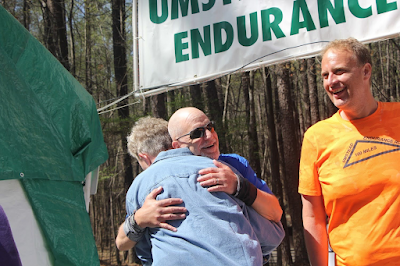
This year's Umstead was hard fought but we got it done, bringing my total number of Umstead finishes to seven. Spent nearly the entire race with one Bill Gentry from Virginia, himself a 17-time finisher of the race. I've known Bill since about 2010 - He's a regular at The Fair - and he's a well known figure in the area's circle of ultrarunners. I can only hope Gentry enjoyed his time with me as much as I enjoyed mine with him.

RD and head volunteer rhonda hugging gentry and I at the finish line

29:33 was the slowest finish for both of us, but neither of us have anything to prove and we're just there for the fun of it. The details of how our race went are not important. If I were to articulate them, they'd attempt to report on my fading memory's account of the highs and lows, perhaps with a preachy overtone, perhaps not. I've read hundreds of race reports like that, and have written dozens myself. I'll probably write a bunch more, but not today.

I have fallen into a pattern where I like to go back to the same races every year, seldom doing something different. All of these are races where my friends go; in fact I made and cultivated these friendships at the races. These races all have that in common, and they're all "parties with my friends."

Umstead however adds something else to this dynamic, and it's somewhat unique among every other race I've ever done. And this has to do with the organization and volunteers that make the race. Umstead literally has more volunteers than it has runners and each and every one of them is .. amazing. And yeah, I know, "all volunteers at every race are great" .. and that's true. But Umstead volunteers are in a class of their own. I've thought a bit about how to characterize it, and the best I can do is this: The volunteers at Umstead uniquely restore my faith in humanity. 

And this characteristic rubs off on all of us who are running it. I run 100s for fun. But I'm convinced that Umstead - in addition to being fun - makes me a better person. And it's the race or the effort, but rather being surrounded by hundreds of Umstead volunteers that make it that way.

That's it. That's the post. Hope you all are doing well.

Jun 23, 2021

TGNY 100 2021: 29:55 - DFL (unofficial)


This past weekend I ran The Great New York 100 Mile Running Expedition.

tl;dr: I reached 100 miles in 29:55, but missed the 100k cutoff so my finish is unofficial.

My early optimism was diminishing as the forecast deteriorated in the week prior to the race, culminating in a 90F+ degree day. But I never considered not showing up at all. My umstead DNF in March was weighing heavily on me (no pun intended) and I addressed it by going on a liquid only diet, for which I am now carrying around about 20 fewer pounds: Not as much as I would have liked before TGNY, but a lot better than nothing. 

Still, I was publicly positive and made plans as usual to hang out with friends during the race, particularly Oak and Mary. Oak was in the same starting wave as I (5:02) and Mary was 5:04. We planned to have her catch up to us in The Park and power through the race, "party barge" style. 

So we were off, it was cool in the morning, and when we got to The Park we ran a continuous mile to get the streak out of the way and then proceeded with walking the uphills, running down, and run-walking flats. Mary soon caught us and then quickly dropped us on a downhill and was out of sight. Oak and I stuck together, in no rush, moving at a decent pace, averaging about 12 minutes per mile even with walk breaks. Once we got to the Hudson River Pathway I started jogging easily and continuously 2-3 miles all the way to the bridge. By the time we got there, Mary was only a few meters in front of us and we hiked up the hill together.


And so it was through the rest of Manhattan, all the way to the Bronx. This early in the race most of the fast runners in later waves had caught up and having not seen many of them since before covid, we chatted a bit and got caught up. 

I've completed the 100 mile and 100k version of this race once each but paced people enough that I've done the entire course probably four or five times - so I knew it pretty well and could repeat it from memory. But there were big course changes this year - the pedestrian pathway for the Henry Hudson Bridge was now open, meaning we no longer had to cross Spuyten Duyvil Creek by going over to Broadway first. Instead, the course crosses the HHB and proceeds north along the Hudson River, crossing through the neighborhood of Riverdale and going through parks there which had a few miles of really nice singletrack trail. We went all the way north to the Westchester County line before turning east and towards Van Cortlandt Park.


The new route in Van Cortlandt is far more windy and technical than the old, and I would have a hard time remembering it. But soon we were back on familiar trails and back on the old course, until we weren't again. There are more Bronx changes in the Soundview section, and I have to say these changes are a massive improvement. Instead of doing an out-and-back in City Island (which I didn't mind at all), we instead follow the coastline on non-technical singletrack, maintained pathways and neighborhood streets, and it all was very nice. The course was a bit confusing at first but now that I've done it I think I can do it again from memory. By this point, Denise had joined us and the four of us were in a bit of a loose group. After Soundview Park, there is yet another course change, removing the worst part of the entire 100-mile course under the Bruckner Expressway and instead has us running down Southern Street which is parallel to the Bruckner and showed me a part of the city I was unfamiliar with and has many restaurants and bodegas for optional support.


It is also at this time that the heat is starting to bear down on us. Oak offered me an ice bandana and, while initially reluctant, I took it and holy hell that was nice to have. I think I owe my race to that ice bandana. I feel like that was the difference between clinical heat exhaustion and just a hot day. I knew to slow down and take it easy, but the sheer exposure was starting to take its toll. With all the significant course changes past us, we entered Queens and, in the hottest part of the day, dedicated every moment to being a little farther along than the last. Oak mentioned running and I said no, too hot. He immediately understood. Near LGA a neighborhood guy named Joe - a trail angel - set up a garden hose spraying heat-affected runners - and even offered ice and water to us. That guy is a hero. Shortly after dousing myself in the spray of his hose I was able to run pretty much non stop the next mile to the aid station at the World Fair Marina. 

The heat was taking its toll on others too. We were starting to hear about people dropping. Mary dropped and Denise was taking care of foot issues in Astoria, leaving just Oak and I for the eastbound trek in Queens. The afternoon wore on and so did the heat. We walked all the way through Flushing and then Fort Totten and the Cross Island Parkway Bike Path. At a point here, Oak and I made a pact. We knew that the 100k cutoff at 9pm was slipping away - we agreed to continue self-supported and finish the course. A fistbump sealed the deal and we were relieved of the pressure to push to 100k by 9pm.

Before exiting the CIP path, Denise caught us and immediately agreed to join our pact. I more or less knew that the finish wouldn't be official so I really wasn't in the mood to kill myself to get to 100k faster and risk heat exhaustion or a late-race deathmarch. And, even though it didn't matter anymore, we still thought we could finish the entire course before the race ended at 11am. Oak's pacer met him at the aid station at Alley Pond Park, and Denise's met her at the aid right after Kissena Park. They worked on some issues again while Oak and I continued - by the time we reached Flushing Meadows, Denise and her Pacer were running. Both pacers were going to try to get us to 100k before the cutoff. But I knew the math - it was 3 or 4 miles away and we had just a few minutes to get there. 

By now it was late evening and starting to cool off, and we're running the majority of the time. Due to a missed turn on their part we actually got ahead of Denise and her pacer and the pacer got news that the cutoff was delayed to 9:30pm. But it was 9:15 and the 100k line was still almost two miles away. We put in a decent effort but it didn't matter, arriving about five minutes late.

Officially, this was the end of the race. Dwight was running the aid station and he told us we were officially done by asking if we would continue for an unofficial finish. Yes, of course. He made sure we understood we'd have no aid. "We're going to be self supported." While taking care of stuff, changing shirts, swapping out gear, Dwight handed me a 100k finishers certificate. Thank you Dwight but I don't want that. Denise, having stomach issues, opted not to continue, so Oak and I headed off into the night, down through the Richmond Hill section of Queens. This two mile stretch, straight down 108th St, goes through a residential area with broken sidewalks, music playing loudly in houses, and plenty of marijuana. It also has a Popeye's that's open til the wee hours. We stopped and got dinner - a chicken sammich and fries - and continued down into Howard Beach. Since it's possible the 7-11 there is the last aid for 20 miles, we stopped again and fueled up. Continuing south, the Howard Beach aid station was indeed gone. Midnight clicked over on the way to the Rockaways and I started running, for the streak. We ran a mile and a half continuously before reaching the neighborhood of Broad Channel and then the bridge to Rockaway. The next aid station, at the boardwalk, was gone. We stopped for a moment there, aware that this - mile 71 - is the farthest point of the course from the starting line. From here we would turn west and head back to Times Square. It was 1am.

The Boardwalk at Rockaway is longer than it used to be, and we get to go farther before moving onto the street and running through the quiet neighborhood there in the middle of the night. Then we run through Riis park. The aid station here was gone. We then turn north off the barrier island over the Gil Hodges bridge into Brooklyn, then along the Belt Parkway into Sheepshead Bay. We arrived at the aid station there at 4am, it was just about to close. Also, other runners officially in the race were there! We left, no longer DFL (this didn't last - they passed us back two miles later.) 

I tried to run a bit on the 1.5 mile long Coney Island Boardwalk but it was futile. It was now somewhat light out and I was hitting a wall. When we got to Cyclones Stadium I had to sit down and recover. I took some caffeine and Advil and started trudging along again. Oak and his pacer were looking for a bathroom, so they tucked into a diner and I continued down the trail, and the advil/caffeine worked and started jogging again, all the way to the next aid, which marks the beginning of the 4.5 mile long pathway under the Verrazano Bridge. I grabbed three slices of cold pizza from the aid and started walking. After wolfing them down I started jogging and kept it up all the way to the bridge - a distance of almost two miles - which is remarkable for me that late in a race. I took a walk break and then started running again - all the way to the end of the pathway, another mile and a half.

The penultimate aid station was still open and soon we were on Fourth Ave, a 3 mile stretch of sidewalks and traffic signals late in the race. Prior to the race, Oak was really jazzed to run TGNY and see the city. On Fourth Ave, I asked him, "have you seen enough of the city?" "Yes." 4th Ave is placed, as if strategically, to frustrate people who are ready to be done. It is an endless countdown of streets, from 66th to 1st, with numerous enticing delis and coffee shops to hold up your progress. Finally you pass 1st street and then cross the Gowanus Canal on a bridge that is probably the most rickety in the Five Boros before turning north on Court St and going through Carroll Gardens and Cobble Hill, which are neighborhoods best described as "you can't afford to live here." 

I was doing ultra math and knew I had plenty of time to finish in under 30 hours, 22-23 minute miles would do it. I also was capable of running about 13 minutes per mile. I could walk 20 minutes per mile, but walking faster than that was aggravating my chafing and blister issues. I was tired and didn't feel like pushing it.

Oak and his pacer saw my walking pace, unable to keep up with their 17s and not running, and reckoned that I was giving up on a sub-30 finish. They went ahead and dropped me. Later Oak expressed regret but honestly it was the right thing for them to do. I arrived at the final aid station alone and, knowing I was the last runner, I just drank directly from a half empty water bottle to save time and got on the bridge.

It was starting to get hot out and the approach to the Brooklyn bridge is long and exposed but I still felt well enough to run down the other side of it and go up Centre Street, where I started my leisurely stroll up Manhattan. The only thing I made sure to do here was stay on the shady side of the street, because the sun was getting brutal. As I got into the numbered streets I was checking my watch repeatedly, making sure I had enough time. I discovered in the first mile of the race that Coros watches don't report an accurate pace in city settings with large buildings, so instead I was doing a street countdown against minutes remaining. I was staying ahead of schedule, getting stopped by the occasional red light. Finally I was in Herald Square with less than 15 minutes to go. I made it across 34th street, which is a real pain to get stuck at, and was frustrated by the lights north of there. I figured I was probably still ok, but just to be sure I jogged a few blocks, catching those lights, until I was at 40th with 5 minutes to get to 42nd. I knew at this point I'd be fine no matter what, so at 10:57 I strolled into a group of nervous looking friends and acquaintances at the finish line who remarked that I "came out of nowhere" to finish. I looked at my watch - and I had a bit over two minutes to spare. Perfect.

Phil was very nice, he shook my hand and congratulated me but then said he was sorry he couldn't give me a finisher's award because I missed the 100k cutoff. I immediately told him not to worry about it, it's all good - and it's not because I don't want to be "that guy" (although I don't want that either.) Besides the fact that I have enough buckles, I also have a tremendous amount of respect for Phil and his perspective on the situation is no doubt super complex and nuanced.  But from my perspective, the explicit agreement when I left the 100k aid station was that I would be going for an unofficial finish. There is no expectation that I would get any award at all. I was grateful that he waited for me, many minutes after his last official finisher came in.

I will say that the distinction between an official and unofficial finish is meaningful only to certain people - but not to me and not to most of my friends. Of course I would prefer to have an official finish, but I do not regret one bit missing that cutoff. I ran the race I needed to run at the pace that I needed to finish under 30 hours, and from my perspective I executed it perfectly. So on the ultra list I include discussion of the distinction, but on social media I don't bother. 

I am a bit overwhelmed at the tremendous outpouring of support from people - some that I disagree with ("he should have just given you a buckle!") and more that I agree with ("You’ve proved once again that the 100 miler is a race of persistence"), and some that just make me blush. ("The DNOF is one of the most impressive feats in ultra running.") Even in this year with terrible weather and COVID restrictions and the absence of Fred who couldn't make it, on balance it was a wonderful experience. I return to TGNY year after year because it is one of those special races and Phil is one of those special people. I'll always make room on my calendar to participate, one way or another.

Postscript. Oak, in from out of town, Remarked in mile two, "Central Park smells great!" 
"Oak, I don't think that has ever been uttered by anybody ever in the history of New York."


May 28, 2021

Umstead 2021: DNF

 I posted this to the ultralist back in April but I'm only just now remembering to copy it here


1000 words about why I DNF'd umstead

This past weekend I returned to Umstead, a little heavier, and a little bit less trained. Umstead is .. well, umstead. I look forward to it every year, seeing all the faces that I've grown to love, and over the years I've developed a sentimental attachment to the race. In normal years, I'd bring my family, meet up with a couple dozen friends, and especially fred. And in normal years, Fred and I would at least run the first few laps together, as we have done "literally many times." Yeah, Fred. Who I knew wasn't coming but messaged me as I was entering the park on Friday to inform me that he was back in the hospital dealing with post-COVID complications. Still there today.


In retrospect, I had no business showing up to the start line of a 100. I have not taken a DNF at umstead since 2011, and have accumulated six finishes at Umstead since then. In fact, it was at umstead in 2019 where I recognized in myself a sort of internalization of the notion that you don't quit in 100s (that's Fred's influence right there). I remember where I was, in 2019, near the Brain Tree, when I was running the course and I just knew that I was in for a tough day but that I would finish. Nothing was going to keep me from continuing. And I noticed that I had already internalized it, probably at some previous race, and here for the first time, it was already there.

It was a combination of many factors - self-identity of that never-quit characteristic, the extra hour they were giving us this year, and Fred himself, who was vicariously running the race with me, that I refused to believe that I was incapable of running 100 miles in 31 hours. And with Fred back in the hospital I had a sense of purpose: I need to do this, for Fred. But I also knew - by the numbers - weight 320lbs, total running in the previous 3 months <250 miles, that this would take more lift than an extra hour. I ignored that and pretended I could somehow power through it and run the race. For Fred.

And at the end of the first lap, which I completed in about 2 hours 50, I honestly thought I was getting away with it! Shortly after the start, I met up with Mary, a friend from brooklyn, experienced ultrarunner and generally extraordinary person, and our plan was to have a party barge where we'd RFM our way through the 100 as slowly as we can get away with. Many of you know Gentry, who texted me before the race to remind me that it's impossible to start too slow. And I took it to heart. 3 hours for 12.5 miles seemed slow enough to me, while still allowing plenty of time to slow down later.

Going out on lap 2, I felt pretty good. We were slowing down a bit, but for the first few miles it seemed that we could keep that lap around 3 hours. A six-hour 25-mile split would set us up for, perhaps a 13-14 hour 50 mile split, which at worst would mean a 17-hour second 50, and I knew I could deathmarch that if I had to. But at the mile-long hill at mile 5 in this lap, I hit a wall and then knew that this would not be a 3-hour lap. And Mary wasn't feeling great either. I don't remember what our time ended up being in lap 2, but it was so slow that I considered throwing in the towel right there. I can easily reach 50, but what's the point in that, there would be no 100 today. (The way to dispense that kind of nonsense is to go out on lap 3.)

Lap 3 was more or less a continuation of the second half of lap 2. I started off a little better, but before we got to the bridge at mile 4 I was back to walking slowly. In fact I don't think Mary and I ran a single step after mile 20. We would take turns going through dark spots, pulling the other along. (In fairness, Mary pulled me along more than I pulled her). 

Meanwhile, weather was happening. It was in lap 3 when we got drenched. The forecast was for sun and warmth. For me, a guy who prefers shade and cold, this wasn't great but I can deal with it. I wore sun protection from the very beginning. But the predawn conditions were cool fog. I sweated through my shirt pretty much immediately, and the fog hadn't lifted before completing the lap. Still believing the forecast, I figured that during lap 2 the sun would come out and dry out my now-heavy sweat laden shirt. But when it was still cool and misty at the end of lap 2 I said fine, the fog wins, put on a tech t-shirt. It turns out we had maybe a few minutes of sun before we could start to hear thunder. And that initial storm that finally hit us while we were on top of cemetery hill - it soaked us to our bones. People elsewhere on the course reported hail. I heard about tornado watches. It was that kind of intense storm, and we were in a clearing at the highest point of the course with a mile or two to go before shelter. And Mary had other issues that manifested during this lap; we agreed that it was necessary to have medical check her out and possibly pull her from the race. We both knew this would take time so I would go out on lap 4 alone. 

So we split up at the completion of lap 3. She went into medical and I went to my drop bag to take care of a few things (put on dry clothes). I felt like I could have a strong lap 4. And if I had a strong lap 4, I thought maybe I could attempt a lap 5 and see what happens. So I got my stuff together and headed out. Made it about 100 meters when I realized my headphones were dead. Considering live headphones to be a critical component of a strong lap, I decided to turn around and get a backup pair. About to head out again, I saw the medical area and thought, "I really ought to check on Mary." Turns out my timing was perfect, she was sitting up in a chair and was just given the go-ahead for lap 4. "We can go out together if you don't mind going slow", she said. I briefly thought about my strong lap 4 idea, realized I was only fooling myself, and agreed. So, thanks to a dead pair of headphones, Mary and I would do the entire 50 miles together. 

My idea of a strong lap 4 seemed like a joke in retrospect. Lap 4 can only be described as a deathmarch for me. Mary was clearly stronger but she was graciously hanging out with me. I felt good for a couple of miles but it didn't last. It got dark, it rained on and off, and we trudged through it, finally finishing 50 miles in something like 16:30 (!!). That lap 4 was the hardest lap 8 I ever had. And it was also lonely. We went through the entire 3-mile sawtooth section without seeing anyone - we figured, correctly, that the weather had taken its toll on others. At the end of the lap, there was no decision to make. Someone said you can go out and get 100k. Nah. 3 laps or 5, 2 laps or 6, it's all a DNF. No sense in trying to sweeten it. I took a shower and went to sleep.

Umstead has and always will be special to me, and there will never be a time when I'm unwilling to go there. But whatever makes umstead special to me was different this year. At packet pickup, it was quiet. Nobody was around. People got their stuff and left. Same for Sunday. Finishers would come in, hang out for a minute, and leave to take care of themselves. So the finish line was just volunteers, busy volunteering. It had to be this way, this year. But next year I'd really like things to be back to normal.

Postscript: There we were, moving along the course, clearly struggling, and, like in all ultras, people would call out "great job!" and "you're doing awesome!" Everyone likes Mary. She has that sense of humor that makes her a pleasure to be around. So her response was always, "that's a lie but thank you!" and everyone would chuckle. But after the tenth time this happened, something occurred to me: They weren't lying. Mary and I were so happy to be there. We were having an absolutely wonderful time despite the discomfort, and it's impossible to hide that. So when people said we're doing great, they weren't referring to our glacial pace, rather the smiles we were wearing. I wish I had finished, it really bums me out that I didn't, especially considering Fred. But I still had a great time, and even though the day proved I had no business being on that starting line, I would totally do it again.

Oct 22, 2019

2019 Badger 100 - Southwest Wisconsin

The same group of folks that I joined in Chicago last year to run the World's Longest Turkey Trot are now full-fledged legit proper race directors, and I was happy to join them for their inaugural race, the Badger 100, held in Southwest Wisconsin.

This Wisconsin Race actually starts in Illinois

Race Director Scott has specifically asked me to write a report on the race, presumably because he think that since I've run a dozen 100s, I know what makes a race good and a race bad.

So I'm going to come right out and say that my easy-to-please ass has nothing critical to say about the race, which must be frustrating to a guy who is looking for areas to improve (I get it, man, I really do) but, unfortunately for Scott and his co-RD Adam, I have to blow them for putting on an outstanding race.

That's not to say there aren't petty annoyances that bothered me, some avoidable, most not. But from an organization and production standpoint the race had no issues, which is no small task for an inaugural race.

the course features a ¼-mile dark spooky railroad tunnel - which 100-milers pass through thrice

Me - on the other hand - I was totally fucked, and it's my own fault. I went out too fast. I didn't drink enough water. I was undertrained, I was overfat, I wasn't prepared for the heat, whatever.

It is interesting that I went out too fast, because even though I know I have nothing to prove, I still run as though I do. My strategy by the numbers wasn't irrational. It was a credible walk/run strategy. Kept it up for a full marathon. And the numbers were not too fast .. in the neighborhood of 12-13 minutes per mile. Yet I wasn't up for even those speeds due to training or heat or whatever, and I knew it.

Anyway, I paid dearly for my early enthusiasm. My finish time - north of 33 hours, is by far the slowest 100 I've ever finished. I walked the second half of the race. I was told I had the ultra-lean. My pace had dropped below 24 minutes per mile. I had to be "un-fucked" by Holly when I came into her aid station with apparent heat exhaustion. I was in bad enough shape that she said she'd not object to me requesting a drop - at mile 93. I had a similar sentiment from a different volunteer at mile 60 - where came in to the aid station so fucked up he assumed I was dropping, and seemed surprised when I got up to go back out on the course to what we both knew would essentially be a 40 mile death march.

Outside of the tunnel, the entire course is like this - railroad easement

Holly sufficiently unfucked me (thanks!) and I was able to continue and finish the race. Scott hugged me and gave me a buckle. I wasn't special, he gave hugs and buckles to everyone who finished. Yet in that moment the thing I appreciated most was Scott's friendship, not my own grit or tenacity. Then I sat down and talked with Joe P, who walked with me for about 25 miles overnight until I couldn't keep up with him anymore. Having just finished, the moment was all about me, but again what I really appreciated was the privilege of spending time with him.

Bringing this full circle, that might be the disappointing lesson of a dozen 100-mile ultra finishes. I don't think I'm any smarter or wiser. What is true is that with less experience I would have quit a lot sooner. Also, with less experience I might have found something about the race to complain about. It was too hot, too exposed, there was too long a gap before that one aid station. But I feel none of those thoughts, rather all I feel is that it was awesome that holly was there to unfuck me, and also the unnamed guy at mile 60, and rachel too at mile 67/74, and of course joe, scott, adam, juli, and everyone else including the stranger I encountered on the trail who said, "Are you Steve Tursi? I heard you are a total savage!" These people are the reason I love doing this.

I finish these things on my own two feet, but in no way am I alone. And while swag and awards are nice, what I really appreciate is a race with a strong and vibrant community of people - which is what the Badger offers.

Apr 17, 2019

Umstead 100 Mile Endurance Run - 2019

Melissa and I shortly after Aid#2 on lap 3 (I think). Photograph by "Someone"
Two weekends ago we all once again headed down to Raleigh to run Umstead. I am a 5-time finisher. My friends Fred and Bill, both of whom I talk to every day, are both in the 1000 mile club (Bill has 15 finishes). And there are at least two dozen other people who I look forward to seeing every spring as we all return to my favorite race on the calendar - among them, Melissa, who has been my running buddy for hundreds of miles, including pacing each other at other 100s, and would be attempting the 100.

The buildup to the race in my case was characterized by my heavier-than-normal out-of-shapeness. Weight is something I've always struggled with, and it has been especially bad the last few years - one lesson I've learned over this period was it's exceedingly difficult to lose weight - or even maintain it - when other things are on my mind. But the vicissitudes of my anxieties are a topic of another time - the point is that I showed up at the starting line up above 310lbs - 15lbs heavier than I was in 2018 when I ran 28 and change - and at least 30lbs heavier than my sub-24 run at Umstead in 2015. On paper, I was doomed.

Melissa, also feeling undertrained, listened to my concerns and resolved to run with me the entire race. We might both die out there, but at least we'll die together. Moreover, she would generously share her crew with me, promising to have them attend to my needs as much as they'd attend to her. I insisted that I don't need anything except maybe a ride to the race in the morning, but appreciated the gesture, and sure- if someone wanted to give me a 5-hour-energy I'd take that. 

And that brought us to 5:59am - Fred, Melissa and I standing behind a pack of 250 runners in the dark, nervously anticipating the gun.

For those who don't know, Umstead consists of eight 12.5 mile loops on gently rolling crushed gravel.

Melissa might have saved my race. Without her I could have pushed myself to run in the 2:30's on lap 1. An easily-run sub-2:30 lap 1 would indicate a level of fitness I didn't possess, and left to my own devices I might have pushed myself just to achieve the number while sabotaging the next 7 laps. Melissa tempered that destructive mindset. As it turns out we ran about 2:50 - nervously long for me - even out of shape I should be well under 3 hours, and be running sub-3s for at least the first three laps, and I knew I'd slow down in lap 2. But Melissa was confident we were fine, and intellectually I knew it too. A fast start ensures against running out of time should I death march laps 7 and 8. A slow start reduces the odds of the death march. I've done enough of these to know better. But occupying my mind was the notion that, at my weight, is a death march unavoidable? "Better run fast, just in case."

Lap 2, with the light out but clouds keeping the sun away, was uneventful and we managed to stay under 3 hours here too - but not by much. I was nervous. Lap 3 was pretty bad - but lap 3 at Umstead is always a low point for me - I've come to expect it. It was over 3 hours. Lap 4 didn't improve, and Melissa was struggling. I suspected that she wanted to drop; take the 50. I wasn't going to let her. And we stuck together, until the hills of miles 7-9. I jogged down a stretch and looked over my shoulder and she was gone. And after walking - slowly - it was clear she wasn't catching up. She was going to drop. I knew it, she knew it. And sure enough, I got a message from her saying that she's giving her crew to me for pacing lap 5. This was unacceptable to me - I was not going to take her crew from her when she needed them the most. My own condition had not improved after my loop 3 malaise however I knew I could do lap 5 on my own and be fine. Afterwards I'll take a volunteer pacer if they had one, and keep going otherwise. 

However, the matter was settled. Melissa made it clear to her crew that she would be dropping and wanted to lie down - there was nothing they could do, and frankly she preferred to be alone. Bill, half her crew, who was also a reserve Navy medic and cross-fitter who had never run more than 8 miles in his life, was going out on lap 5 with me and there was nothing I could do about it. I accepted this. And Bill was great. We weren't running much at this point, and what I needed in the lap where the sun went down was a companion, someone to talk to. Bill was not an experienced pacer but he was good at conversation and had no issues hiking 12.5 miles. Lap 5 was when I started to recover.

When we came back, Melissa was ready to go back to the hotel and her crew would go with her (I obviously had no problem with this.) I asked at the pacer desk for a volunteer and .. someone came out. Someone ("Someone" shall be his name, for in my stupor had forgotten it, and I think I embarrassingly forgot it soon after we started and called him Bill the whole time. I don't think his name is bill. He never corrected me. Sincere apologies, Someone.) Someone was a more experienced pacer and Umstead vet (and photographer) and was good at keeping me moving at a good speed - lap 6 was well under 3:30 - faster than the previous laps. We had a great conversation and I was rallying. We had caught and passed Fred. We passed 15-finish-Bill too. We finished lap 6 ahead of all my friends and Someone joined me on lap 7 as well. We ran the entire airport spur at 2am (necessary for a running streak) and finished the lap in the neighborhood of 3:30, still ahead of all my friends, and shortly after 5am, ensuring that I would finish under the cutoff even in the case a disastrous lap 8. Thanks Someone, you rocked.

I sat down after lap 7 for 10-15 minutes to change shoes, shirt, and just get a little more comfortable in preparation for the final 12.5 miles. I was not concerned about my friends (who deserved to beat me anyway). There were no volunteer pacers available, so I said my goodbyes to Someone, grabbed headphones for the first time in the race, and hit the road. 

The first half of lap 8 was ok. I was moving pretty well, not running much but walking purposefully. In the last five miles, however, I was reduced to sub-22 minute miles. I put on some hardcore punk rock and made the best of it. With two miles to go, my 15-year-old son joined me and walked me in. I finished in 28 hours 17 minutes 14 seconds - faster than last year, when I was lighter and better trained.

So, what got me through it? I guess there's more to running than weight and training. Last year had crummy weather - but that crummy weather is ok with me. But having done a bunch of these - this is my sixth finish at Umstead alone - I suppose I have internalized the values of "just keep going" and don't waste time. Most of my stops at aid stations were minimal - less than 30 seconds. And there was never a notion at all of quitting. There was a desire to quit - I suppose that never goes away. But there was no serious thought given to quitting. No indulgence on heaven or earth would have gotten me to stop. It was work for sure, but I wasn't going to stop until the work was done. And that attitude didn't come to me naturally - I learned it over many years. So I would say experience got me through it. And I'm sure luck had a lot to do with it too.

I don't know how to finish race reports. Bye.

Dec 10, 2016

On the Tenth Anniversary of my First Marathon


This is a reflective "what have I learned post."

tl;dr: The friends I made in running are much more meaningful to me than running itself, and I'm extremely grateful to them.

December 10, 2006
This is the only photo I have of my first marathon finish
Ten years ago today, in Las Vegas, on December 10th, 2006, I ran my first traditional-distance marathon. You can read my report if you're interested in my mentality at the time. It's fascinating to me.

2007 Philadelphia Marathon
The following year, in 2007, I would run three more marathons. In 2008, I ran my first ultra (a 50k), followed by a 50 miler. That was the year I ran the Chicago Marathon. By 2009 I was attempting 100 milers. In 2010, I finally finished 100+ miles in a single event - in a 72 hour fixed time race where I hit 100 somewhere north of 60 hours. It wasn't until 2012 when I finished a fixed-distance 100-mile race under the 30-hour cutoff.
Tammy and I at Umstead 100, 2012
I tend not to run normal marathons anymore. In fact I haven't run one since 2013. Marathons aren't challenging - or, I should say - I don't run marathons in a challenging way. Marathons, run properly, are actually the hardest race there is; which is why I don't do them.
That time in 2008 I drove to Chicago to run a marathon with Rizzo - then drove home that night.
Instead, I run ultras. And, for the last few years, almost exclusively 100 milers or 24-72 hour fixed time races. They're social events for me, which leads me to the point of this post. But I'll preface my monologue it by saying I used to take racing much more seriously. I was frightened of DNFs, and had the typical pre-race anxiety that most runners get before a big race. These days, DNFs are rare, and though I still approach 100-milers with nervous anticipation, my anxiety comes from elsewhere in life. And while there's no shortage of the anxiety I feel from non-running activities; it's a topic for another time. (Preferably in person, with adult beverages in front of us.)

Anne, Ami, and Joey on my 40-mile 40th birthday run earlier this year
I am going to tell a tale here of two runners, and will refer to my first runner as the "real" runner. Someone in a podcast that I love calls this person "the douchebag runner", which is not meant pejoratively but rather in jest. I think it's funny; laugh every time I hear it,  but I'm not going to use it. If you're this person, you're not a douchebag to me. I'm going to give you the respect you deserve and call you a "real" runner.

("but some of my best friends are douchebags..")

I won't go into too much detail in describing the real runner, because you already know him or her. The real runner is interested in being the best runner they can be, and they're going to put in the hard work to be it. Real runners are admirable. Real runners do track work, tempo workouts, and hill repeats. Real runners count their calories, figure out which macronutrients to eat, measure their VO2 max, know their lactate threshold, are aware of exactly which heart rate zone they should be in at all times, and carefully plan and select the races they run. In most ways, real runners are better than me. A large part of me envies real runners. I wish I had their discipline and dedication. If I was a real runner, I'd probably be thin. And their fast finish times wouldn't be bad either.
Me pretending to be a real runner at the 2014 Wharton 5K - I ran 23:56
But, alas, I am not a real runner. I am the second persona: the social runner.
Stopping to shoot a selfie with the kids mid-race
Point of clarification: before I go any further I must say that the two archetypes are not mutually exclusive. Real runners in fact tend to be quite social.  And social runners almost always do care about finish times and will push for a good time in a race. But any experienced runner will tell you that almost everyone has a prevailing mentality, and for the purposes of this post I'm going to assume a clear distinction for convenience's sake.

Melissa and Ami are two of my favorite people in the world, and I deeply value their friendship
Most people who begin running as adults start out thinking they should be real runners. I was a real runner when I ran that marathon in 2006, despite my nearly-7 hour finishing time. They obviously don't call themselves real runners; they just think they're normal runners (and, to be sure, they are.) Some people stay real for the rest of their lives. Many people burn out and quit running altogether. But a lot of us, and I fit this pattern, transition from real runners to social runners.
That time I ran a beer mile in a blizzard with Jen
It starts out innocently enough. You make some running friends. Maybe they're online, maybe they're at work, maybe you met them at a race. These friends become training partners. And you get to know them, their families, their jobs, their interests and hobbies. Soon, you're doing long runs with them. Or you're entering long races with them. If you run with them enough, you'll learn their secrets, their fears, their anxieties. And these people who you've gotten to know deeply: you're now suffering with them. In 100 milers it's particularly poignant - you'll find yourself suffering with someone at 3am on the side of a road. You keep each other going, feeding off the other's energy.
RJ and I, 4AM, mile 87.5
And without realizing it, you've long since stopped caring about your VO2 max. All you give a shit about anymore are the friends you've made. You care about them far more than you care about any stupid race. And they care for you. They care about you, and listen to you in a way only a true friend can. And the value in suffering together with a friend far outweighs the value in finishing in a certain time. You'll find yourself seeking out longer and harder events - because more intense and time spent suffering with them leads to deeper and more meaningful friendships.
Fred and Ami, my most valued running friends
To put it succinctly, you start out with them because they provide a transactional value to you: the quantifiable benefits of having a training partner. But soon their friendship becomes more meaningful than some economic arrangement. You want to spend time with them because of their intrinsic human value. The fact that you get a training partner is just gravy.
Melissa, my other most valued running friend
Running for me has become part of my identity, and so when I interact with non-runners they tend to assume that I'm the first persona. They think that running 100 milers in some way resembles the way their cousin runs 5Ks. I guess for some 100-mile runners it does, but they're not like me. What I do is in no way similar to what the real runner does. It's not better or worse, but different. In fact the only thing I have in common with them is we run. "Running" seems like something that unites us, but not really. I can sometimes hang with real runners, especially if I want a hard workout for some reason, but they're typically not interested in hanging with me. To them, the way I train - at slow paces with lots of walk breaks (and sometimes a pizza and beer break) is a waste of their valuable training time, and that's OK. Everybody has their priorities.
Some of my amazing tri club friends after an early morning track workout
Everyone has their reasons when they start running. For me it was weight loss.
400 lb Steve in the late 90s, with my cousin Sue. She is 21 now.
And to be sure, if I stopped running tomorrow then my weight would probably balloon back to four hundred pounds. But I don't run to maintain weight. I run instead to maintain the circle of friends that mean more to me than running ever will. And to those friends: I can't overstate the gratitude that I feel. Thank you for the conversations both serious and light hearted, the opportunity to suffer together, and the insights I've gained into myself by your companionship. I'm a dramatically different person than I was ten years ago - much more honest, empathic, and disciplined - and I can't give credit to running; but rather to you.

To each and every one of you - thank you.
Ami and I before Beast of Burden 2014 - her first 50 miler!
With Eric and Tony
Tony taught me everything I know about running ultras.
 
That time I was on a Badwater Crew for Tony (2010)
Also: Chris, Eric, Meredith, Eddie, Herb

Jim

Suzanne

Stephen, Bill, Jim

Tammy, Fred 
Stephen


Marge

Lynn David Newton
My tri club
Dr. Larry
Gary and Bob
Cliff
The Three Days Crew, 2015
Dave
Randy and Phil 
Melissa, Rick, and the Kids
Dusty
Anne
Dong
Hasher friends
Jonathan (matching socks)
April

RayK and Melissa
More Hashing Friends 
Fred and Andy

I thought it would be fun to enumerate all the marathon-and-longer distance events I've completed in the last ten years:

Marathons
Las Vegas (2006)
Self-Transcendence (2007,2009,2010)
Breakers (2007)
Philadelphia (2007)
Chicago (2008)
Big Sur (2009)
NYC (2009)
Marine Corps (2011, 2013)
NJ Marathon (2013)

Ultras
Across The Years 72 hour (2x)
Ancient Oaks 100 mile
Beast of Burden 100 mile
Booty Rumble 50K
Caumsett 50K (2x)
Damn Wakely Dam 32.6 Mile (2x)
Forgotten Forest 9 hour
Ghost Train 100 mile
Grand Teton 50 mile
Hinson Lake 24 hour
Hudson valley recover from the holidays 50K
JFK 50 mile
Knickerbocker 60K (2x)
Lake Waramaug 50K (2x)
NJ One Day 24 hour (3x)
NJ Ultra Festival 50 mile
North Coast 24 hour
Parsippany 12 hour (2x)
Russell B. Cheney 50K
San Francisco 50 mile
Ted Corbitt 24 hour
The Great New York 100 mile
Three Days at the Fair 48 hour (2x)
Three Days at the Fair 72 hour (4x)
Umstead 100 mile (3x)
Umstead 50 mile (2x)
Vermont 50K

Also: Ironman Florida (2012)


Final thought. 2016 has been a rough year for me in many ways. We received lots of bad news this year, and coping has been difficult for me. Two of the reasons for this are of ultrarunning friends - people who I spent time on the trail with, but not enough time - and who I wish I knew better - passed away.

Eric and I in late 2015. He suddenly and unexpectedly passed away suddenly 
earlier this year. He was a kindred spirit, a lot like me. Family man and 
unapologetic back of the packer, who forged his deepest friendships while running.

I had the distinct pleasure of sharing a few miles on the Ancient Oaks course with Stu Gleman in 2014
He passed away from cancer in September, shortly after finishing one last 100-miler

Here is a tribute to him, written by Laz
(ARFTA = A Race For the Ages; fixed time event that Laz puts on.)

the old guys at the ARFTA have stories to tell.
they have a love of life to share.
and lessons to teach.
greatest of those lessons...

to savor the moment.

when we are young,
we do the things that young men do.
we hurry always.
barely able to finish one thing,
before we must rush off to experience the next.

what irony that those
with all the time in the world
are the ones in a hurry.
and only when we feel the limits of that time
do we learn to slow down,
and savor the moment.

stu gleman was one of us at the ARFTA
savoring the moment.
it was his best performance in a long time.
it was his "one more hundred"
as, shortly before the clock ran out,
he completed his 110th circuit of the deadman mile.

for those who shared laps with him;
old friends who talked of days and races gone by,
new friends who might have heard the stories
the many stories
of a man who grew up poor in the west virginia hills
ran his first ultra in 1962
and was a NASA scientist,
when we were putting men on the moon.

stu was one of a kind.
i am sure the tributes will come
and the stories will be told.

what i remember most were his words a few days before the race.
ARFTA did not fit easily in his schedule,
but
"it is important that i come.
i have friends who will be there,
and i need to tell them that i love them."

we all know in our minds that we are not guaranteed tomorrow.
there comes a time in our life that we know it in our hearts.
stu knew it in his heart.

i am so glad that i had the chance to savor those moments with stu this weekend.
i am sorry that there were not more.
because there are no more tomorrows.

stu passed away tonight.

all that i have now are the memories.
but those will shine brightly,
until i have my own last tomorrow.

stu gleman was one of a kind.